Cowboy Boot Toe Types: Snip, Round, Square and Which to Wear in Texas
*Disclosure: This post may contain affiliate links. If you make a purchase, we may earn a small commission at no extra cost to you. Thanks for supporting TwoStep and Tequila!
The main cowboy boot toe types run from narrow to wide: snip and pointed, then round and roper, then cutter and narrow square, then square and wide square. Narrow toes dress a boot up and lengthen the line under a skirt or midi. Wider toes give your forefoot room for a long day on your feet, and round is the safe middle. Toe shape is mostly style, not function, and the names change from bootmaker to bootmaker, so here is each toe in plain English, how it wears and what to put with it.
Texas Monthly’s boot-buying guide says the toes of your boots, “whether they are pointy, round, or square, will say a lot about who you are.” We took that as an invitation. Partway through, we sketch a playful Texas toe map, narrow for the dress-up nights out west and wide for the work boots in the piney woods. Fair warning: that map is our opinion over a margarita, not survey data, and we say so where it appears.
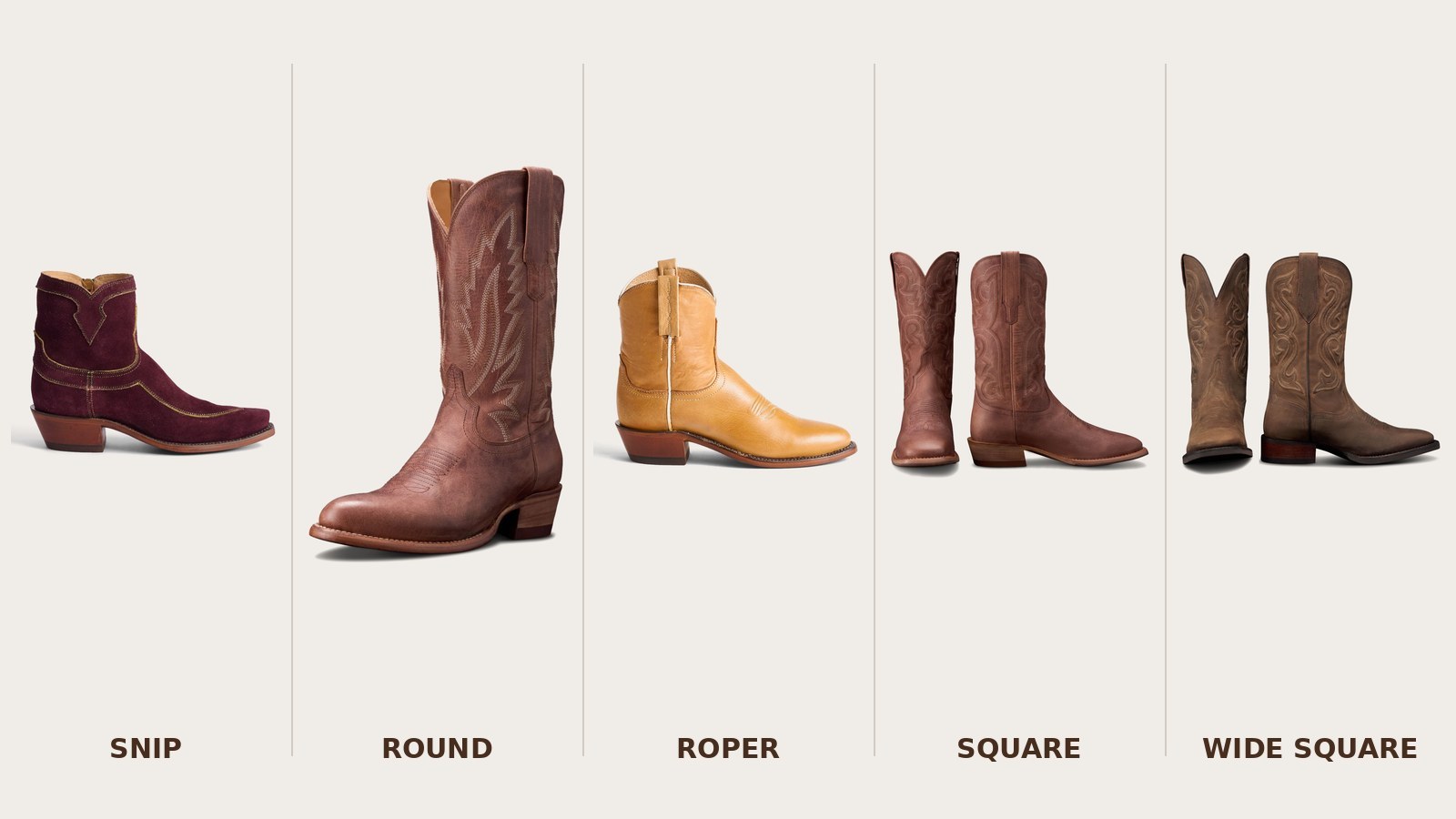
The cowboy boot toe types, narrow to wide
First, a warning: there is no standard naming. Alvies notes that its J toe is “also called a Pointed toe or a 1 toe,” and that “different toe styles sometimes even use the exact same name.” Ariat’s “R toe” is a narrow, oval regular toe, while Lucchese’s R toe is a roper, the roundest of the bunch. Texas Monthly agrees that “the specific nomenclature of toe styles varies from maker to maker.” Use the shape, not the letter, and check the toe width if the brand lists one. The table below uses the most common names.
| Toe | What it looks like | Best for | Watch for | Try one (when we checked) |
|---|---|---|---|---|
| Pointed (J toe, roach killer) | Tapers to a point | Dressing up; the classic western line | Least toe room; check the width at the ball of the foot | Alvies makes its classics in this toe (see its toe guide ) |
| Snip (Lucchese 5 toe) | Pointed, then squared off slightly at the tip | Dresses, skirts, dancing, evenings | Tapered, so read fit reviews and widths | Tecovas Daisy $295; Lucchese Sadie $695 |
| Regular (narrow round; Lucchese’s closest is its 2 toe) | Narrow and oval, almost a point | First “real” boot; dress and traditional wear | Can run narrow across the toes | Lucchese Summer $1,295 (see our Lucchese vs. Tecovas comparison) |
| Round (Lucchese 6 toe) | A curved, medium front | Everyday, riding, walking, standing | Roomier than snip, narrower than square | Tecovas Jamie $345 |
| Roper (Lucchese R toe) | Rounded U-shape, like a regular shoe toe | Short boots, low heels, everyday | Looks casual; the short shaft is part of the style | Lucchese Gaby $595; Tecovas Earl $325 |
| Cutter | Narrower than square, wider than regular | The regular look on a wider foot | Less common; names vary | Ask a boot store for its cutter lasts (Ariat’s guide explains the shape) |
| Narrow square (John Wayne, box, punchy; Lucchese 7 toe) | Squared tip, narrow footprint | Dressy-casual, modern western | Corners can bunch skinny hems | Lucchese Patsy $495 |
| Square | Broad, squared front | Walking, work, casual wear | Can read chunky with a slim dress | Tecovas Maggie $375 |
| Wide square (broad square, Lucchese W toe) | The roomiest, squared and broad | Wide or swelling feet, long days, work | Biggest look; widths still matter | Tecovas Tess $295; Lucchese Ruth $375 |
For a sense of scale, Lucchese publishes widths on its toe chart: its 5 snip toe is 5/8 inch wide, the 7 western square is 7/8 inch, and its W square toe is 1 1/2 inches. The widest toe on that chart is more than twice as wide as the snip.
Narrow toes: snip and pointed
A snip toe tapers like a pointed toe and then stops in a small flat cut. Texas Monthly describes it as a pointy toe “slightly squared off, or ‘snipped,’ at the tips,” and Ariat says snips are “usually found in dress boots.” Jim’s Western Wear says pointed toes are commonly chosen for formal western outfits and dancing, and snips for a polished look. In our eyes, a snip is the toe that dresses a boot up the most: it sharpens the foot under a dress or skirt and adds length to the leg.
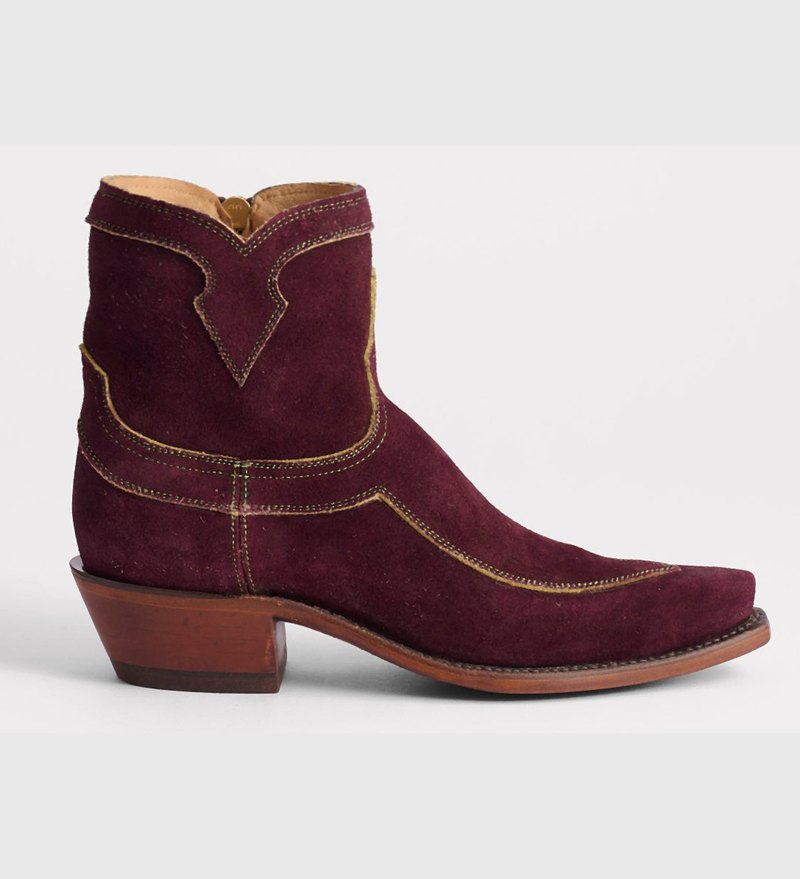
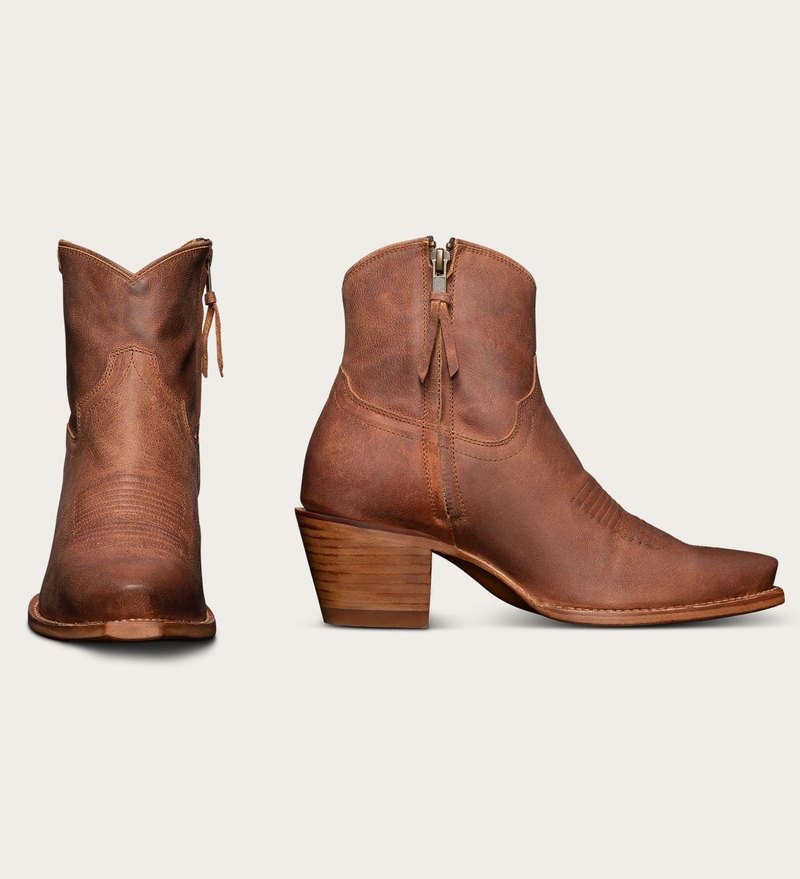
The fit catch. Narrow toes are not automatically a squeeze. Jim’s notes that the front of a boot is often longer than your foot, because the last extends past the toes, and that “your toes should sit in the widest, most comfortable portion of the toe box rather than being forced into the very tip.” Still, a narrow toe leaves less room for a wide forefoot, and Tecovas says round toes put less pressure on your toes than pointed or snip toes do. If your forefoot is wide, look for a snip in a wider width, or step up to a round.
Do pointed toes really help in a stirrup?
Everyone has heard it: the point helps your foot find the stirrup. Lucchese’s own toe chart says its snip toe was “originally made for getting in and out of a stirrup.” Ariat and Tecovas say something similar about narrow and round toes. But True West calls the story shaky, saying “toe styles on cowboy boots are more about style than function” and that “scant evidence—if any—proves that pointed toes were even around before Tom Mix showed up in movies wearing narrow, snip-toed boots.” The magazine adds that feet found the stirrup fine in round or square toes, and that cavalry boots in the Civil War were round or square. So treat the stirrup as a good story, not the reason to choose a toe.
In the middle: round, roper and cutter
Round is the toe the boot world agrees on. Texas Monthly says rounder toes are favored by “gentlemen and gentlewomen ranchers, business types, and everyday boot-wearers,” and that if it is your first pair, “the traditional Western toe, which is rounded and narrow, is the toe for you.” Tecovas says a round toe is easy in and out of stirrups and comfortable “while riding, walking, and standing.”
A roper is the roundest and most shoe-like, usually on a short boot with a low heel. Ariat says it was named for cattle roping, and Lucchese describes the roper as “most like a normal shoe toe shape.” The cutter is a quiet in-between: Ariat says it is “narrower than square toe boots but wider than regular,” and a good option “if you want the look of a regular toe but have wider feet.” True West links the cutter name to cutting-horse riders, who it says have embraced narrow-to-wide square toes.
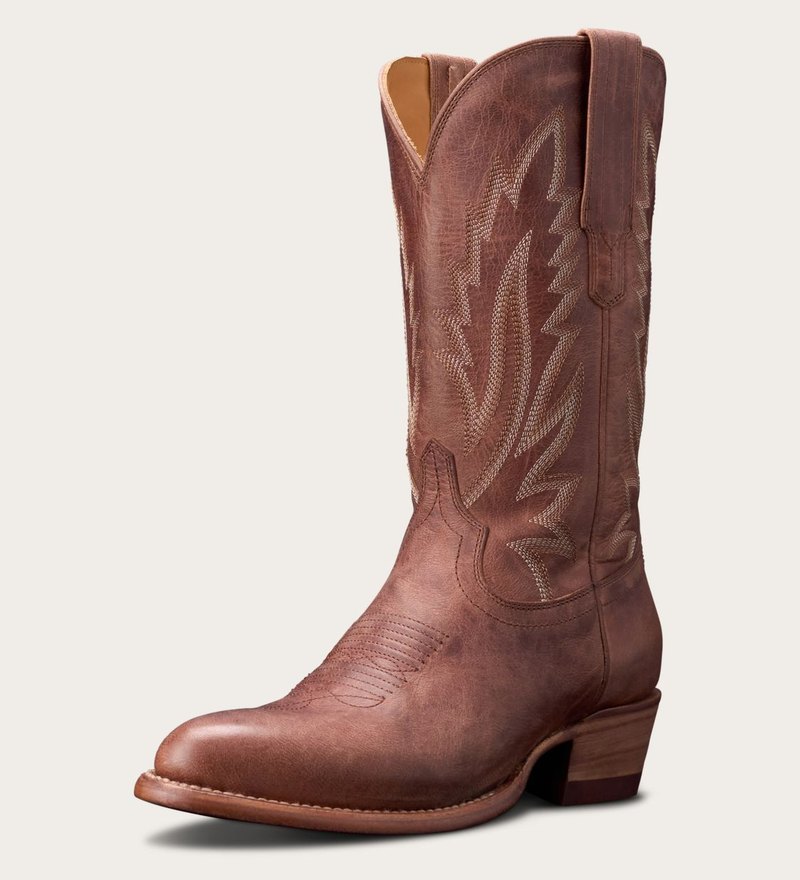
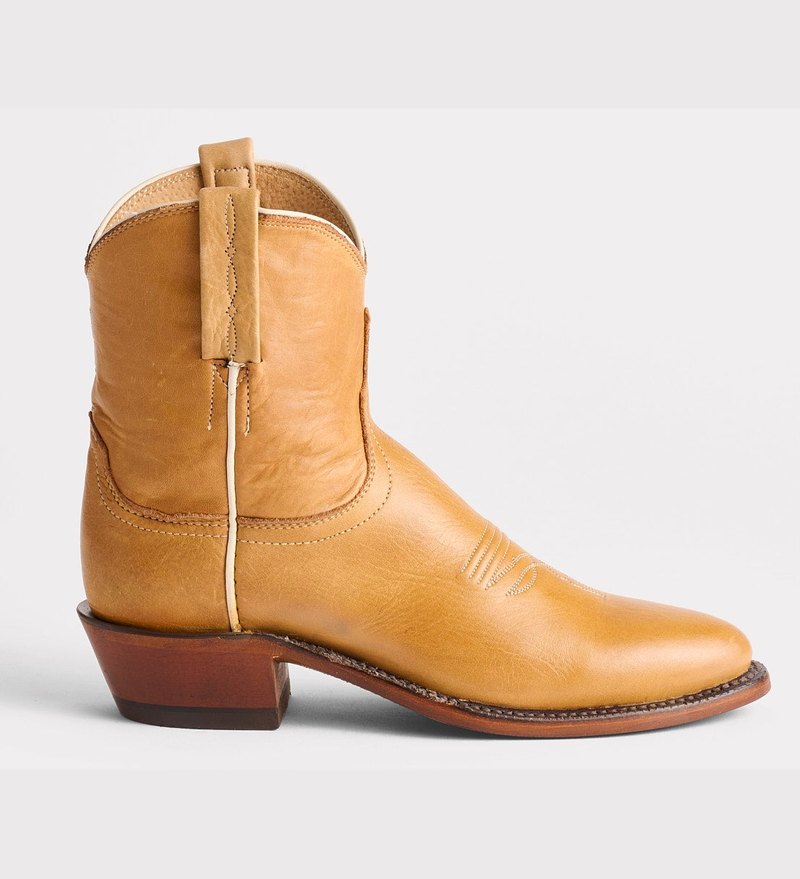
If you want a toe that does everything, this is where it lives. Our everyday western boots guide is built around that idea: one round-toe pair you can actually walk in.
Wide toes: square and wide square
Square toes come in a range. Texas Monthly lists everything “from subtle box toes to the broad square toes,” and says the “John Wayne” is the narrow square, also called a box or punchy toe. At the wide end, Tecovas calls its broad square the “roomiest toe box in the game,” a welcoming option for feet that are “wide, extra wide, irregular, or prone to swelling.” It also calls square toes the most comfortable for long days of walking and working on foot. Ariat says square toes are comfortable for both walking and riding, and Lucchese says its W toe is “found on walking & riding boots and is known for its comfort.”
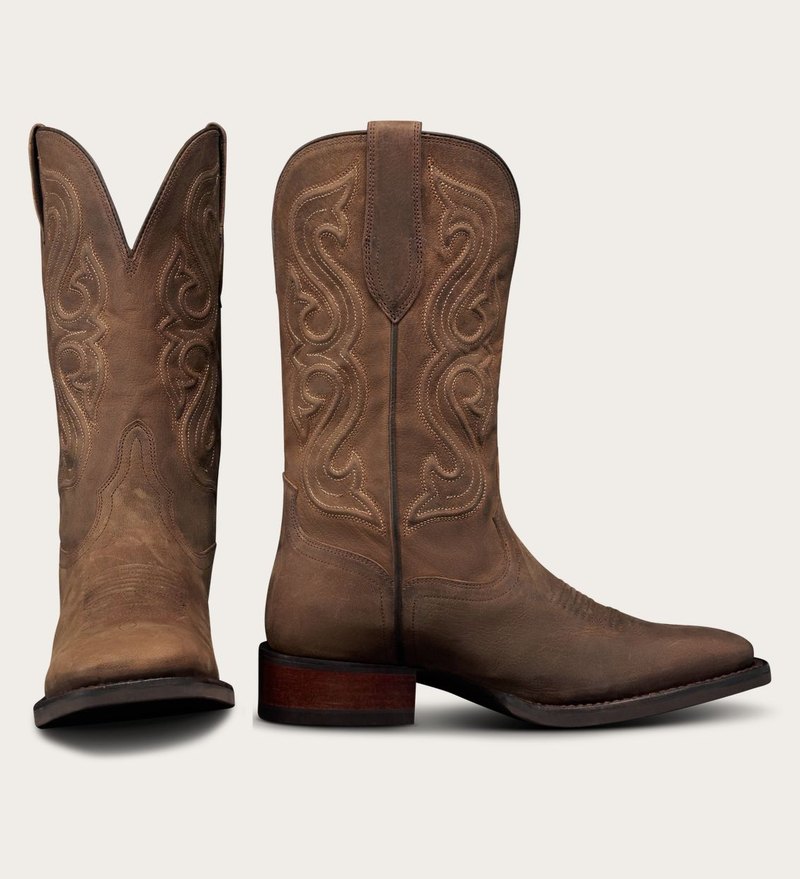
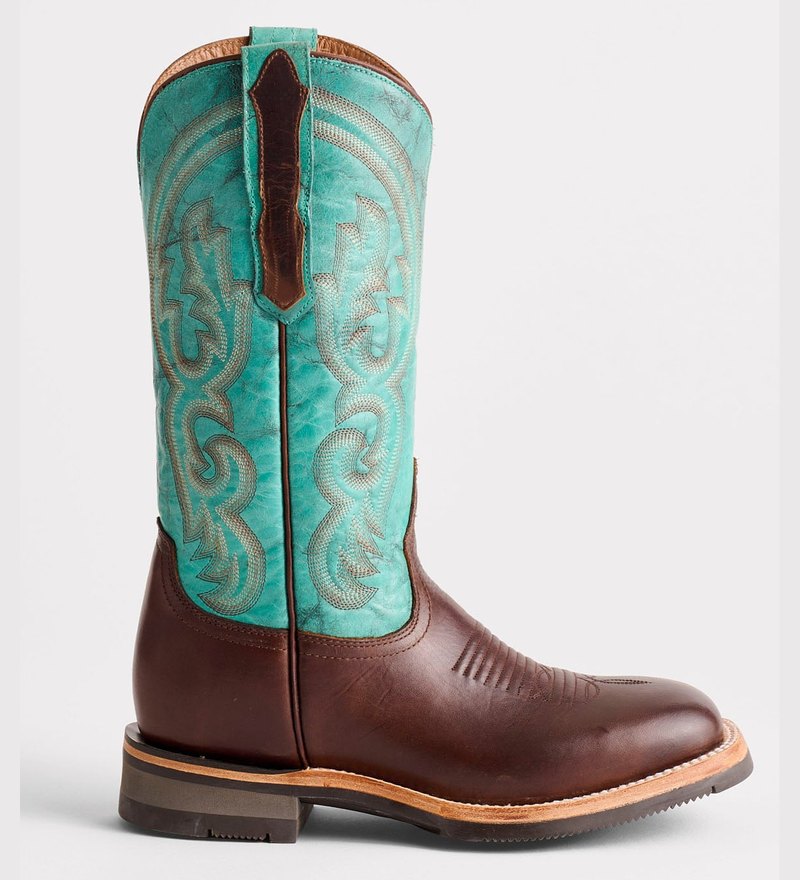
The fit catch. A wide toe is not a wide boot. Jim’s warns that “a wide square toe can still be too narrow,” so compare the real width, not the label. And a wide square is a lot of boot visually: under a slim dress it can look chunky, which some people love and others don’t.
Does the toe change how a boot fits?
In theory, no. Alvies says “the toe shape is actually supposed to have zero impact on how a boot fits,” because fit “should always start behind the toe.” In practice, lasts vary, and a few brands let the toe pinch the forefoot. What does hold across the makers we read: a boot should be snug like “a firm handshake,” with toes flat and room to wiggle, and Texas Monthly says a quarter-inch to half-inch of heel slip at first is normal. Jim’s adds two good tests: try boots on at the end of the day, when feet are a little larger, and keep the ball of your foot over the widest part of the sole.
Width matters as much as toe. Lucchese sizes women’s boots in A, B and C widths (A narrow, B average, C wide), so toe shape and width are two separate choices. Our Lucchese vs. Tecovas guide breaks down what the fit options look like on a $1,295 boot next to a $375 one.
What to wear with each toe
This is our styling take, not a rule.
- Bootcut jeans. The hem covers most of the boot, so any toe works. Jim’s says square toes pair well with boot-cut and relaxed-fit jeans.
- Straight-leg jeans. The toe shows, so it matters. A snip or narrow round keeps a straight leg sleek, while a wide square gives it a workwear feel.
- Skirts and dresses. A snip or narrow round extends the leg line below a midi or knee-length skirt. A square toe makes a modern contrast with something floaty. See our skirt with cowboy boots guide for the hem-and-shaft formula.
- Short boots and booties. With the shaft out of the picture, the toe does more of the talking. A roper bootie reads casual, and a snip bootie reads dressed up.
A Texas toe map: our read, not a survey
Here is the playful part. We looked for a survey of which boot toes sell where in Texas and didn’t find one. Bootmakers don’t publish regional sales by toe, so what follows is style lore and a little squinting at Texas boot culture, the kind of thing said over drinks. It is an opinion, and you are welcome to argue with it.
West Texas, dressed up (our read). When the night calls for a good dress and a good boot, think a Midland benefit dinner, a Marfa gallery opening or an El Paso wedding. Our hunch is the boot that shows up is narrow of toe and fine of leather, a snip or a 2 toe in smooth black calf. Here is what we can back up, and where we start guessing. Dress boots do skew narrow: Ariat puts snips in dress boots, and Lucchese, which opened in San Antonio in 1883 and has been in El Paso since 1986 per its own timeline, makes its Summer in a 2 toe, “a more narrow rounded toe that almost comes to a point.” Whether luxury buyers out west pick narrow toes more than anyone else is speculation, and we have no data on it.
The twist. West Texas also wears the widest toe in the state. Texas Monthly says the wide square is the preferred choice of “frat brothers, West Texas landmen, and rodeo cowboys.” So we’d say West Texas is a two-boot place: the wide square at the rig and the snip at the ball. We would bet plenty of people own both.
East Texas, where the boot has to work (our read). Our porch-swing theory is that a roomy toe, a wide round or a wide square, is the boot for the pickup, the pew and the pasture gate. We have no data or quote for this at all, and plenty of East Texans, including a few who dance in snips, will tell us we are wrong. Consider it a fond guess.
Our toe map is a porch-swing theory. Your feet get the final vote.
What we can say with sources: narrower toes lean dressy, wider toes lean comfortable and work-ready, and Texas Monthly says square toes have been gaining popularity. Beyond that, pick by foot and occasion, not by zip code.
Which of the cowboy boot toe types is right for you?
- First pair, or one boot for everything: a round toe. It’s the traditional pick Texas Monthly points beginners to, and Tecovas calls it comfortable for riding, walking and standing.
- Wide forefoot, swelling or all-day wear: a wide square. Tecovas and Jim’s both point wide feet toward it. Check the actual width.
- You want the regular look on a wider foot: a cutter, which Ariat calls the in-between.
- Dresses, skirts, dancing and evenings: a snip or narrow round. Try it at the end of the day with the socks you plan to wear.
- You want a statement: a snip. Alvies, which makes mostly J toes, says its snip is “for people who want to stand out a little.”
- Ropers and everyday short boots: a roper toe.
Quick answers
What are the main cowboy boot toe types? Pointed, snip, regular (narrow round), round, roper, cutter, narrow square, square and wide square. Names vary by bootmaker, so check the shape.
Which cowboy boot toe is most comfortable? Tecovas says square and broad square toes are the most comfortable for long days of walking and working, and round is easy for riding and walking. Fit still depends on width, so try them on.
Are snip toe boots comfortable? It depends. Jim’s says comfort comes down to the boot’s last, width, materials and your own foot shape, and Tecovas says round toes put less pressure on your toes than snip toes do.
Do pointed toes help in a stirrup? Lucchese says its snip was made for stirrups. True West says the evidence is scant, and that round and square toes worked fine too.
Do West Texans wear narrower toes than East Texans? We don’t know. We found no survey. Texas Monthly says West Texas landmen favor the wide square, and the rest in our toe map is our opinion.
Prices and specs were checked on lucchese.com and tecovas.com on October 27, 2026 and can change. All brand links are plain links, not affiliate links. Product photos are from each brand and show the boots named in their captions.
Keep exploring
For more western looks, start at the Western Outfit Hub. To see how the narrow-toe luxury end compares with a more everyday boot, read our Lucchese vs. Tecovas guide. For the walkable pair, see our everyday western boots guide, and for the dress-up version, our skirt with cowboy boots guide.